






When Everything Feels Important: How to Decide What Actually Deserves Your Attention

Share
Some to-do lists are easy to prioritize.
Take out the trash or submit the application due at noon?
Probably the application.
Other lists are harder because nothing on them is obviously unimportant.
Finish the project.
Call your parents.
Exercise.
Deal with the insurance issue.
Work on the thing that could move your career forward.
Buy groceries.
Reply to the person who has already followed up twice.
Book the appointment you've been postponing.
Make progress on a goal you keep saying matters to you.
Rest, because apparently humans require that too.
The problem isn't always that you're wasting time on meaningless things.
Sometimes too many things genuinely matter.
And that's when ordinary prioritization advice starts to feel a little insulting.
You don't need someone to tell you to "focus on what's important."
You need a way to decide what gets your attention when several important things are competing for the same limited time, energy, and brain space.
That requires a different question.
Not:
"Is this important?"
But:
"Does this deserve priority right now?"
Those are not the same thing.
Important Does Not Automatically Mean Priority
This distinction changes a lot.
Your health can be important.
Your family can be important.
Your work can be important.
Your finances can be important.
Your friendships can be important.
Your home can be important.
Your creative life can be important.
None of that tells you what to do at 10:30 on Tuesday morning.
Importance describes value. Priority determines order.
A priority is what receives resources first when resources are limited.
And your resources are limited.
You have limited:
- time
- attention
- energy
- money
- emotional capacity
- decision-making bandwidth
So prioritizing inevitably means allowing something important to wait.
That is often the uncomfortable part.
Why Everything Starts Feeling Equally Important
When your list gets crowded, several different signals can begin to blend together.
A deadline feels important.
Someone else's request feels important.
Something you've postponed for a month feels important.
A task connected to a major goal feels important.
Something making you anxious feels important.
An easy task that you could finish immediately suddenly feels strangely important.
A notification arrives and—congratulations—it has nominated itself for priority status.
Current prioritization guidance commonly separates urgency from importance for exactly this reason. The Eisenhower Matrix, for example, distinguishes tasks based on those two dimensions rather than treating them as interchangeable.
That's useful.
But real life often needs another layer.
Because two things can both be important.
Two things can both be urgent.
And sometimes the thing that matters most has no deadline at all.
So instead of forcing every task into a single ranking immediately, start by figuring out why it matters.
The Four Reasons Something May Deserve Your Attention
When you're struggling to prioritize, run the task through four different lenses.
Think of them as directions rather than scores.
1. It protects something non-negotiable
Some things deserve attention because neglecting them creates a meaningful consequence.
A bill has to be paid.
A deadline has to be met.
Your child needs to be picked up.
A commitment you deliberately made needs to be honored.
A problem will become substantially harder or more expensive if you ignore it.
These are your non-negotiables.
Notice that "non-negotiable" should be a fairly exclusive club.
If 19 things qualify, we have once again invented a to-do list.
Ask:
What genuinely has to happen?
Then:
What happens if it doesn't?
Real consequences make priorities easier to see.
Imaginary guilt makes them harder.
2. It moves something meaningful forward
Not everything important has a deadline.
In fact, some of the things that shape our lives most dramatically are remarkably quiet.
Writing the book.
Building the business.
Learning the skill.
Saving money.
Working on the portfolio.
Having the conversation.
Making time for the relationship.
Creating something that matters to you.
These tasks are easy to postpone because nothing explodes when you ignore them today.
Or tomorrow.
Or next Tuesday.
They simply remain undone.
This is why a day can be incredibly busy and still leave you wondering:
What did I actually move forward?
A useful priority should not only prevent problems.
At least some of your attention needs to create progress toward something you intentionally chose.
Ask:
If I keep postponing this for six months, will I care?
That question often reveals importance that urgency hides.
3. It sustains your ability to keep going
This category is routinely sacrificed in the name of productivity.
Sleep.
Food.
Movement.
A functioning home.
Administrative maintenance.
Time with people who matter.
Rest.
Space to think.
Things that don't necessarily create obvious progress but help keep the machinery of your life from rattling apart.
They may not look ambitious.
They are still important.
You cannot make every day about maximum forward movement because some attention has to go toward sustaining the person doing the moving.
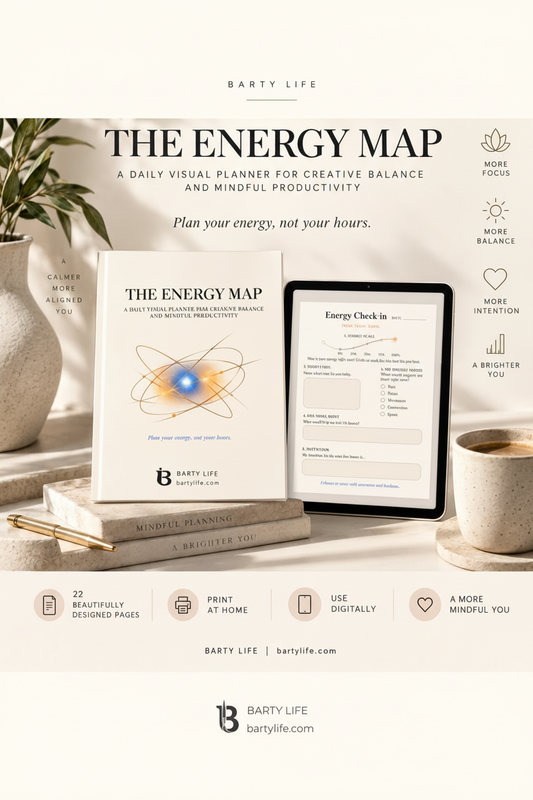
If you find that your energy levels are consistently affecting what you can realistically prioritize, The Energy Map is built around exactly this—helping you notice your current capacity, identify what would be supportive, and adjust your priorities accordingly.
Ask:
What helps keep my life functional enough to continue?
That belongs in the priority conversation too.
4. It is simply loud
And then there is the fourth category.
The email that just arrived.
The notification.
The request with somebody else's deadline attached.
The thing you're suddenly worried you "should" be doing.
The task you keep checking because it's easier than the work that matters.
The minor problem demanding disproportionate mental space.
Loud things are excellent at impersonating priorities.
Recent prioritization advice increasingly makes this distinction explicitly: what is demanding attention is not necessarily what has the strongest reason to receive it.
Ask:
If this weren't making noise right now, would I still choose it?
That question is surprisingly effective.
Try the Consequence Test
If two tasks still feel equally important, stop asking which one "feels" more important.
Ask what happens when each one waits.
For each task:
What happens if I don't do this today?
Then:
What happens if I don't do it this week?
Then:
What happens if I don't do it this month?
You may discover:
Task A creates a real problem tomorrow.
Task B can comfortably wait four days.
Task C has no immediate consequence, but repeatedly postponing it is quietly blocking an important goal.
Task D produces almost no meaningful consequence at all.
Now you have information.
Prioritization becomes easier when consequences replace vague pressure.
Try the Leverage Test
Some tasks matter because completing them makes several other things easier.
Those deserve special attention.
Imagine this list:
- write homepage copy
- choose photos
- email designer
- fix product descriptions
- review homepage layout
- create launch posts
Everything belongs to the same important project.
But perhaps the designer cannot proceed until the homepage copy is finished.
That changes the priority.
If your competing priorities are primarily business-related, The Calm CEO Planner is designed to help you navigate exactly this kind of decision—identifying what to protect, what to move forward, and what to let wait, without burning out in the process.
Ask:
Which action unlocks something else?
Or:
Which unresolved task is causing other tasks to remain unresolved?
The answer is often a better priority than whichever task feels easiest to finish.
Try the Alignment Test
Now we get to a question that traditional urgency-based systems sometimes miss.
Does this actually support what matters to me right now?
Not everything useful is useful for your current direction.
You can have a wonderful idea at exactly the wrong time.
You can discover a worthwhile project when you already have three worthwhile projects underway.
You can receive an interesting opportunity that pulls attention away from something you've already decided matters more.
This is why clarity has to come before prioritization.
Without a direction, almost any reasonably good idea can argue its way onto your list.
With a direction, you have a filter.
For example:
My focus this month is finishing the website.
Suddenly:
"Research a podcast idea" may still be interesting.
It just isn't now.
"Redesign my entire filing system" may still be useful.
It just isn't now.
"Start developing another product" may be exciting.
Still not now.
Priorities become much easier when they are answering to a direction instead of competing in a popularity contest.
Your Priorities Should Not All Be the Same Kind
There is another reason "top three priorities" can fail.
Imagine today's list:
- Finish major client project.
- Prepare presentation.
- Solve complicated insurance issue.
Congratulations.
You have successfully selected three things capable of ruining your afternoon.
A more realistic priority set often includes different roles.
One thing that must happen
The real deadline, commitment, or consequence.
One thing that moves life forward
Something connected to a meaningful longer-term direction.
One thing that supports or sustains you
An action that keeps tomorrow—or you—from becoming harder to manage.
Some days the same task covers two categories.
Great.
The point is not to create another rigid formula.
It is to prevent your definition of "priority" from becoming:
the three most stressful things I can think of.
What About the Eisenhower Matrix?
It is popular for a reason.
The classic framework separates tasks into:
- urgent and important
- important but not urgent
- urgent but not important
- neither urgent nor important
It can be extremely useful for quickly sorting a crowded workload.
But you do not need to use it for everything.
The difficulty is that importance is subjective.
"Exercise" might be important.
"Finish proposal" might be important.
"Call Mom" might be important.
"Work on side business" might be important.
A matrix can categorize them.
It cannot decide what kind of life you are trying to build.
That's your job.
And that is why values, current direction, consequences, energy, and existing commitments belong in the conversation too.
A Better Question Than "What Is Most Important?"
Try this instead:
What deserves my attention first, given the life I'm actually living right now?
That sentence contains several useful constraints.
Deserves asks you to make a judgment rather than react.
My attention reminds you that attention is finite.
First means you don't have to declare everything else meaningless.
Actually living forces the plan to account for reality.
Maybe your big personal goal matters deeply, but today you genuinely have a work deadline.
Handle the deadline.
Your goal didn't stop mattering.
It simply wasn't first.
Maybe the house is messy, but you have two uninterrupted hours and a project you've been trying to finish for months.
The laundry can survive the experience.
Maybe the ambitious thing can wait because you're running on fumes and what would help most is food, an early night, and making tomorrow easier.
That isn't failed prioritization.
That is prioritization.
The "Not Now" List Is as Important as the Priority List
If you have too many worthwhile ideas, goals, projects, and responsibilities, create a deliberate Not Now list.
Not deleted.
Not abandoned.
Not evidence that you're incapable of doing everything.
Just:
Not now.
For example:
Now
- finish website
- maintain current client work
- exercise three times a week
Not now
- start podcast
- redesign office
- create second website
- take new course
- develop another product line
This gives good ideas somewhere to live without requiring them to compete for today's attention.
You can revisit the list later.
The relief comes from knowing that postponement was a decision, not an accident.
Sometimes the Priority Is a Decision, Not a Task
Here's another category worth noticing.
You might not need to do more.
You may need to decide.
Decide whether you're actually going ahead with the project.
Decide whether you're attending the event.
Decide whether you're keeping the commitment.
Decide whether the idea belongs this quarter or next year.
Decide whether you need to have the uncomfortable conversation.
Decide whether you're willing to stop doing something.
Unmade decisions create strange to-do lists because every possible path remains mentally open.
You keep planning around all of them.
Sometimes clarity arrives when you close one.
If your difficulty is less about the task list and more about repeatedly reconsidering the same decisions, the CEO of Overthinking Journal was made for exactly that—helping you work through the loop, make the call, and move forward.
The Barty Priority Compass: Think in Directions, Not Just Rankings
This is the philosophy behind The Clarity Compass.
Instead of treating your life like one giant stack of tasks that needs to be numbered from 1 to 47, the planner asks you to look at what is pulling your attention in different directions.
Its Priority Compass uses four points:
North — Non-Negotiables
What matters most?
What must remain protected?
What are the priorities you don't want daily noise to push aside?
East — Energizers
What gives you momentum, motivation, or energy?
What helps you move toward the person or life you're trying to build?
South — Sustainers
What keeps you grounded and functioning?
What supports your wellbeing, stability, and ability to continue?
West — Wastes & Distractions
What drains time, energy, or attention without meaningfully supporting your direction?
The actual Clarity Compass system uses these four categories to help users distinguish core priorities from energizers, sustainers, distractions, and drains.
That matters because life rarely fits neatly into one numbered list.
Sometimes the question isn't:
"Is Task A more important than Task B?"
It is:
"What role is each of these playing in my life?"
Once you can see that, choosing becomes easier.
Try This Five-Minute Priority Reset
If you're looking at too many important things right now, take a blank page.
Write down the five to ten things competing hardest for your attention.
Then ask each one:
1. Is there a real consequence if this waits?
If yes, note what that consequence actually is.
2. Does this move something meaningful forward?
If yes, name what.
3. Does this sustain something I need?
Your health, relationships, home, finances, energy, stability, or basic functioning all count.
4. Is this mainly loud?
Would you choose it if nobody were asking, reminding, notifying, or watching?
5. What happens if I deliberately say "not now"?
Not "I hope I get to it."
Not "maybe later."
Deliberately:
Not now.
Then choose what receives attention first.
You do not need to establish the universal ranking of everything you care about.
You only need enough clarity to choose your next direction.
You Are Allowed to Have More Important Things Than Current Priorities
This may be the distinction that makes prioritization feel less brutal.
Choosing one thing does not mean declaring everything else unimportant.
Your family can matter while you're working.
Your business can matter while you're resting.
Your health can matter on a day when exercise doesn't fit.
Your creative goal can matter during a week when an unavoidable responsibility needs more attention.
Priority is temporary.
Importance can remain.
Once you stop demanding that every important thing receive equal attention at the same time, prioritization becomes less like choosing winners and losers.
It becomes an act of direction.
What needs protecting?
What moves something meaningful forward?
What sustains me?
What is simply making noise?
What can I consciously choose not to carry right now?
You don't need to care about fewer things.
You need to stop asking all of them to be first.