








How to Plan When You Feel Overwhelmed: A Simple Reset for When Everything Feels Like Too Much

Share
There is a particular kind of overwhelm that makes even a planner feel offensive.
You already know there is too much to do. You do not need a fresh page politely asking you to list all 37 things.
Work needs something. Home needs something. Someone is waiting for a reply. There is an appointment you almost forgot, a project you keep moving to tomorrow, three "quick" tasks that have somehow survived for two weeks, and one important thing you cannot seem to think clearly enough to start.
So you make a list.
The list gets longer.
Now you have all the original problems plus a documented inventory of them.
Helpful.
When you feel overwhelmed, planning should not begin with squeezing everything into your day. It should begin by making the day easier to understand.
That means fewer decisions, fewer competing priorities, and a clearer answer to one question:
What actually needs my attention now?

Why Planning Feels Harder When You're Already Overwhelmed
Planning sounds like one task.
It isn't.
To make a plan, you may have to decide:
- what needs doing
- what matters most
- what is urgent
- what can wait
- how long things will take
- what order to do them in
- what you have enough energy for
- what someone else is expecting from you
- whether you are forgetting something
- whether choosing one thing means neglecting another
That is a lot of decision-making before you have actually done anything.
This helps explain why adding another sophisticated productivity system can make an overloaded day feel worse rather than better.
People describing this problem online often say some version of the same thing: they have task managers, calendars, notes, lists, or productivity tools already, but still feel as though they are juggling too much or cannot decide where to start.
The answer is not automatically a better app.
Sometimes you need less planning before you can plan well.
First: Stop Trying to Plan Everything
When everything feels important, the instinct is often to capture and organize every open loop.
There is a place for that.
But not necessarily at 8:17 a.m. when your brain already feels like it has 14 browser tabs open and one of them is mysteriously playing music.
Your first goal is not:
Organize my entire life.
It is:
Create enough clarity to know what to do next.
That is a much smaller assignment.
And small assignments are useful when your mental bandwidth is already occupied.
The Barty "Clear Before You Plan" Reset
Use this when your usual planning routine feels like too much.
You can do it on paper, in your phone, on the back of an envelope, or inside a planner.
The tool matters less than the sequence.
Step 1: Name what is making today feel heavy
Before writing every task you can remember, ask:
What is actually creating the feeling of overwhelm right now?
Maybe it is:
- one looming deadline
- five people needing answers
- too many unfinished small tasks
- an unclear project
- several equally important priorities
- something emotionally difficult that you have been avoiding
- a schedule with no breathing room
- the feeling that you are already behind
Try to be specific.
"I have too much to do" is true, but not very useful.
"I have three things due today and I don't know which one to start with" gives you something you can work with.
"I'm worried about the presentation, so I keep doing smaller tasks instead" gives you something even better.
Clarity often begins when the problem gets a name.
Step 2: Separate commitments from mental noise
Now write down what is competing for your attention—but do not treat every thought as an equal priority.
Create four rough categories:
Must happen
These have a real consequence if ignored today.
A bill due today. A work deadline. Picking up your child. Medication you need to refill. A scheduled appointment.
Matters, but not necessarily today
Important does not always mean immediate.
Planning next month's project matters. Updating your portfolio matters. Organizing the closet may matter.
None of that automatically means today.
Could make life easier
These are small actions that would remove friction.
Putting gas in the car. Ordering groceries. Sending one piece of information someone needs. Laying out what you need for tomorrow morning.
Noise for now
This is the category many planning systems forget.
Things can exist without deserving today's attention.
Ideas. Things you "should probably" do. Tasks with no meaningful deadline. Something you remembered because you happened to see it. A project you care about but realistically cannot touch this week.
You are not deleting these things from your life. You are removing them from today's meeting.
Step 3: Choose one direction before choosing several tasks
A common planning mistake is jumping immediately from "I have too much to do" to "Here are my seven priorities."
Seven priorities are usually just seven tasks wearing expensive hats.
Instead, decide what kind of day this needs to be.
For example:
Today is about finishing the client proposal.
Today is about getting the household back to functional.
Today is about handling the three things with real deadlines.
Today is a recovery-and-maintenance day, not a catch-up day.
Today is about making tomorrow easier.
That sentence becomes a filter.
When another task appears, you can ask:
Does this support today's direction, or is it simply asking for attention?
Those are not the same thing.
The Clarity Compass uses a similar principle through its "One True Daily Direction" and a limited set of core priorities rather than treating every possible task as equally significant.
Step 4: Pick three priorities—but give them different jobs
"Choose your top three" is common productivity advice.
The problem is that three enormous priorities can still create an impossible day.
Instead, give each priority a role.
1. The anchor
This is the thing that most clearly supports today's direction.
If you complete only one meaningful thing, this should probably be it.
2. The support task
This keeps life moving.
It might be an email, appointment, household task, admin job, or something practical that prevents tomorrow from becoming harder.
3. The small win
Choose something realistically finishable.
Not because easy tasks are always more important, but because visible progress can help a stuck day start moving.
If you find yourself struggling to start even small tasks, The Momentum Maker Planner is built around exactly this: small, intentional actions that build movement without relying on motivation alone.

Your plan might look like this:
Direction: Get the presentation under control.
Anchor: Draft slides 1–10.
Support: Email Jordan for the missing numbers.
Small win: Confirm tomorrow's meeting time.
That is a plan. Not a complete representation of everything occurring in your life. A plan. There is a difference.
Step 5: Decide what you are not doing today
This is one of the fastest ways to make an overwhelmed plan feel believable.
Write a short Not Today section.
For example:
Not today:
- reorganizing the whole inbox
- researching new project-management software
- fixing the closet
- starting the next presentation
- answering messages that can wait until tomorrow
Saying "not today" is not the same as saying "never."
It simply prevents tasks from renegotiating their importance every six minutes.
And if everything stays available for selection all day, you are forced to keep deciding all day.
That is exhausting.
Step 6: Make the first step embarrassingly obvious
"Work on taxes" is not a good first step.
Neither is:
- deal with emails
- start project
- sort finances
- clean house
- work on business
- get organized
Those are categories of suffering.
A first step should tell you what your hands actually need to do.
Instead of work on taxes: Open last year's tax folder and find the income documents.
Instead of start presentation: Open the deck and write the titles of the first five slides.
Instead of clean house: Put everything on the kitchen counter where it belongs.
Instead of catch up on email: Reply to the three messages connected to active projects.
When you are overwhelmed, reducing ambiguity matters. You should not have to solve the task again every time you look at it.
Step 7: Plan for the energy you actually have
Sometimes your priorities are perfectly clear and the plan still feels impossible.
Check the missing variable:
What is my actual capacity today?
Not your ideal capacity. Not Tuesday-you from three weeks ago who slept eight hours and had suspicious amounts of optimism. Today's capacity.
You might have a high-focus day. You might have enough energy for steady administrative work but not deep creative thinking. You might have a genuinely low-energy day where the appropriate plan is smaller.
The Energy Map is built around this exact distinction: instead of organizing time alone, it asks you to notice your current energy, identify what would be supportive, and adjust priorities accordingly.
Capacity does not decide what matters. But it absolutely affects how you approach what matters.
If your anchor task normally takes two focused hours and today you have 30 usable minutes, the useful question is not: "Why can't I get this done?" It is: "What meaningful part can I move forward in 30 minutes?"
What If Everything Really Is Urgent?
Sometimes "everything feels urgent" is a perception problem. Sometimes your week has simply gone feral.
There genuinely may be several deadlines, responsibilities, and consequences landing at once.
In that situation, do not force yourself to magically identify one perfect priority. Use consequences instead.
Ask: What happens if this waits until tomorrow?
Then: What happens if this waits three days?
Then: Who is affected if I do not do this?
Then: Can the deadline, scope, standard, or responsibility be changed?
This last question is easy to miss.
Planning is not only deciding when you will do things. Sometimes it means deciding:
- to ask for an extension
- to delegate
- to simplify the deliverable
- to postpone something
- to cancel something
- to tell someone no
- to intentionally do a B+ job on something that does not require an A+
- to let a nonessential task remain undone
You cannot prioritize honestly while pretending every commitment is fixed.
The Difference Between a Brain Dump and a Plan
A brain dump can be useful because it gets thoughts out where you can see them. But a brain dump is not automatically a plan.
This:
- call dentist
- finish report
- buy birthday gift
- laundry
- taxes
- reply to Melissa
- book hotel
- update website
- organize files
- renew insurance
- exercise
- meal prep
…is a storage system.
Your brain no longer has to remember everything, which can be helpful. But you still need a second step:
What does today require from this list?
That is where planning begins.
Try the 10-Minute Overwhelm Reset
If you are staring at your day right now and do not want another complicated framework, do this:
Minutes 1–2: Name the pressure
Write one sentence: "I feel overwhelmed because…"
Minutes 3–4: Capture the immediate commitments
Write only what is genuinely competing for today's attention.
Minute 5: Choose today's direction
Finish: "If today moves one thing forward, I want it to be…"
Minutes 6–7: Choose your three
Pick:
- one anchor
- one support task
- one small win
Minute 8: Make a Not Today list
Move at least three things off today's mental desk.
Minute 9: Define the first physical action
What exactly will you open, write, send, move, call, or begin?
Minute 10: Start
Not after perfecting the plan. Not after finding a prettier template. Start.
Or try our free 15-Minute Life Reset.

When a Planner Helps—and When It Doesn't
A planner is useful when it helps you make fewer, clearer decisions. It is not useful when maintaining the planning system becomes its own part-time job.
If you repeatedly abandon planners, that does not necessarily mean you "aren't a planner person." You may simply be using a system designed for a different problem.
A traditional schedule works well when the primary question is: When am I going to do everything?
But when you're overwhelmed, your first question may actually be: What deserves to be done at all?
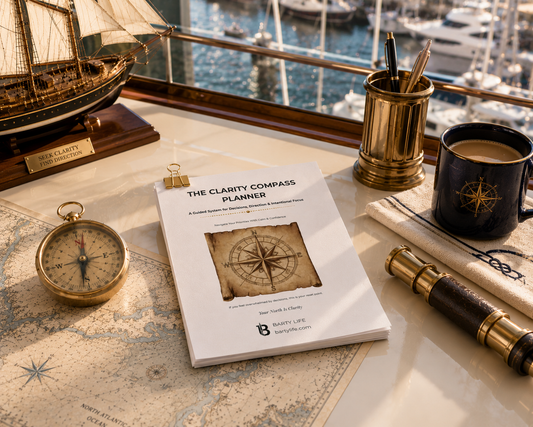
That is the problem The Clarity Compass was designed around.
Rather than centering the system on filling every hour, it guides you through defining non-negotiables, core priorities and longer-term direction; identifying potential distractions; sorting thoughts; working through decisions; and resetting when you feel overloaded or unsure where to start.
Its Priority Compass also separates North: non-negotiables, East: energizers, West: wastes and distractions, and South: sustainers—a more nuanced question than simply asking which task has the earliest deadline.
The current Barty Life product page describes the same core purpose: helping users navigate decisions, organize priorities and reduce mental clutter instead of focusing on productivity alone.
You do not need The Clarity Compass to use the ideas in this article. Grab ordinary paper and try them today.
But if this is a problem you face repeatedly, a structured place to work through those decisions can save you from having to reinvent your reset every time things get noisy.
Not ready for a full planner? The 15-Minute Life Reset is a free, low-friction starting point—a short workbook for pausing, reconnecting with what matters, and refocusing your priorities when everything feels like too much.
A Bad Day Does Not Need an Ambitious Plan
This may be the most important part.
When you feel behind, there is a temptation to create a plan dramatic enough to compensate.
Wake up earlier. Catch up on everything. Clear the inbox. Finish two projects. Exercise. Meal prep. Finally deal with that weird drawer. Become a new person by Thursday.
That plan usually feels reassuring for approximately nine minutes. Then reality arrives.
A useful plan does something less glamorous. It tells the truth about what matters, what fits, what can wait, and what the next move is.
That may mean today's successful plan contains three things. It may mean one. It may mean sending an uncomfortable email that changes the rest of the week's workload. It may mean stopping one project instead of starting another. It may mean admitting that the problem cannot be solved by becoming temporarily superhuman.
That isn't giving up on productivity. It is making productivity realistic enough to survive contact with your actual life.
When Everything Feels Like Too Much, Make the Plan Smaller
You do not need perfect control over everything on your plate before you can move forward.
Start here:
What is creating the most pressure?
What truly needs attention today?
What matters but can wait?
What is one direction I want this day to have?
What is the next visible action?
Then let the rest stay quiet for a while.
Planning when overwhelmed is not about fitting more into the day. It is about creating enough clarity that you can finally see where to put your next step.
And sometimes one clear next step is plenty.