





Decision Fatigue: Why Small Choices Start Feeling So Hard—and How to Reduce the Mental Load

Share
At 9:00 a.m., you can make a reasonably complicated decision.
At 6:14 p.m., someone asks what you want for dinner and suddenly you would prefer to resign from the position of Person Who Chooses Things.
Pizza?
Maybe.
Thai?
Sure.
Cook?
Absolutely not.
"What do you want?"
Anything that doesn't require another decision.
If this sounds familiar, there is a useful term for the experience: decision fatigue.
Decision fatigue describes the mental exhaustion that can come from making many decisions, particularly when they are frequent, complicated, or consequential. It can show up as difficulty choosing, procrastinating on decisions, avoiding them, feeling mentally foggy, or making an impulsive choice simply because you want the decision to be over. (Cleveland Clinic)
And modern life offers an impressive number of opportunities to practice.
What should you wear?
What should you eat?
Which email first?
Should you answer that message now?
Which project needs attention?
Is this purchase worth it?
Which appointment time?
Should you say yes?
Should you say no?
What should you make for dinner?
Should you finally deal with the thing you've been avoiding?
None of these decisions has to be enormous.
The accumulation is the point.
The solution isn't to become better at obsessively optimizing every choice.
It may be to decide which choices deserve your brain in the first place.
What Decision Fatigue Actually Means
Decision fatigue isn't a diagnosis, and occasionally struggling to choose between two options does not mean something is wrong.
It is better understood as a phenomenon in which repeated decision-making can leave someone feeling increasingly depleted and less able or willing to make further decisions. Cleveland Clinic describes common patterns including decision avoidance, procrastination, impulsive choices and difficulty concentrating. (Cleveland Clinic)
The American Psychological Association has also discussed how repeated choices, especially under stress, can make later decisions less thoughtful and increase reliance on habitual or default responses. (American Psychological Association)
In ordinary life, it can sound like:
"I don't care. Just pick something."
"I'll deal with it tomorrow."
"Maybe I need to research this a little more."
"Fine, I'll just buy this one."
Or the classic:
opens 17 tabs, compares everything, chooses nothing.
The important distinction is that the problem isn't necessarily the difficulty of one individual decision.
Sometimes it's the volume of deciding surrounding it.
Not All Decisions Cost the Same Amount of Attention
Choosing between two kinds of toothpaste is not the same as deciding whether to leave a job.
Choosing lunch is not the same as deciding how to spend $10,000.
Picking a movie is not the same as deciding whether to accept an opportunity that changes your schedule for the next year.
Some choices naturally deserve more thought.
Others become exhausting because we accidentally treat them as though they do.
You compare six nearly identical products.
You reread a low-stakes email five times.
You spend 20 minutes deciding which task-management app should contain the tasks you are currently not doing.
You reconsider what to eat every night from the entire known universe of food.
This is where reducing decision fatigue becomes interesting.
The goal isn't:
Make every decision faster.
It's:
Stop spending premium attention on economy-class decisions.
First, Find Your Repeat Decisions
Before trying to improve your decision-making, notice where you're repeatedly making the same kind of decision.
For one day, pay attention to questions like:
- What am I going to eat?
- When will I exercise?
- When should I check email?
- What should I work on first?
- When will I do household tasks?
- What should I wear?
- Should I answer this now?
- What am I doing this evening?
- When will I work on my personal goal?
You don't need to track every microscopic choice.
Look for repetition.
If you are answering essentially the same question every day, there may be an opportunity to answer it once instead.
Create Defaults for Decisions That Don't Need Creativity
A default is simply the option you use unless there is a reason not to.
For example:
Breakfast default: one of three easy breakfasts.
Work-start default: review today's priorities before opening email.
Exercise default: Monday, Wednesday, Saturday unless the week requires adjustment.
Grocery default: maintain a basic repeat list, then add extras.
Email default: check at designated times rather than deciding every five minutes whether now is the moment.
Friday dinner default: pizza night.
Defaults aren't rules carved into stone.
You can change them.
That's the point.
A good default doesn't remove freedom.
It removes the requirement to actively exercise that freedom every single time.
Clinical guidance on decision fatigue similarly recommends reducing choices in routine parts of life and creating predictable routines where appropriate. (Cleveland Clinic)
You don't need to reinvent breakfast every morning to prove you're alive.
Use Routines to Pre-Decide Ordinary Life
A useful routine is essentially a collection of decisions your past self already made.
You don't wake up and negotiate every step.
Coffee.
Get ready.
Walk dog.
Review calendar.
Begin work.
Whatever your sequence is.
The routine reduces the number of questions the morning has to ask.
The same principle can apply at work.
Maybe:
Monday: weekly planning.
Morning: focused work before routine admin.
2:00 p.m.: messages and follow-ups.
Friday afternoon: review open loops and prepare next week.
Research-based workplace guidance from the National Institutes of Health notes that routines can reduce decision fatigue because they decrease the amount of energy spent deciding what to do next. (NIH Office of Intramural Training & Education)
If you want a structured way to build routines that actually stick, The Ritual Architect is designed exactly for this—helping you design intentional daily rituals so fewer decisions have to be made from scratch each morning.
Again, routine doesn't mean rigidity.
If Tuesday catches fire, Tuesday catches fire.
You adjust.
But you don't have to build Tuesday from scratch every Tuesday.
Shrink the Menu
Sometimes the exhausting part isn't making the decision.
It's considering too many possibilities.
Imagine asking:
What should I do this weekend?
Potential answer: approximately everything available to a human being within driving distance.
Now try:
Do I want a social weekend, a restful weekend, or a get-things-done weekend?
Much easier.
Then:
If social: dinner with friends or invite people over?
You've turned one giant decision into a smaller sequence.
This works for purchases too.
Instead of:
Which laptop should I buy?
Start with:
What is my maximum budget?
Then:
What are the three features I genuinely need?
Then compare the few options that survive.
Constraints are not always restrictive.
Sometimes they are merciful.
Stop Researching When Research Stops Changing the Decision
Research can help you make a better choice.
Research can also become a beautifully organized way to avoid making one.
You read five reviews.
Then twelve.
Then Reddit.
Then another comparison.
Then a YouTube video made by a man with very strong feelings about vacuum cleaners.
At some point, ask:
What information am I still missing that could realistically change my choice?
If you can answer that question, go find the information.
If you can't, you may no longer be researching.
You may be postponing.
A useful stopping rule might be:
I'll compare three suitable options.
I'll spend 30 minutes researching this.
Once two independent sources confirm the specification I care about, I'll decide.
Not every purchase or choice needs a dissertation.
Separate Reversible Decisions From Expensive Ones
One reason small choices become exhausting is that we sometimes treat them as permanent.
But many decisions are reversible.
Try the class.
Change the software.
Order the other meal next time.
Move the desk.
Test the routine for a week.
Change your mind.
For reversible decisions, ask:
If this turns out to be wrong, how difficult is it to change?
If the answer is "not very," you probably don't need certainty.
You need a reasonable choice.
Save deeper thinking for decisions with higher consequences or higher costs of reversal.
Decide Your Decision Deadline
Some decisions need more thought.
Fine.
Give them a container.
For example:
I'll decide by Thursday at 5:00 p.m.
Until then, you can gather relevant information.
At the deadline, choose.
This prevents a decision from becoming permanent background software running in your head.
Because unresolved decisions have a habit of showing up at inconvenient moments.
While showering.
While driving.
At 2:07 a.m.
While you're supposedly watching a movie.
"Oh, hello. Have you decided about that thing yet?"
A deadline tells your brain there is a scheduled moment for the choice.
Ask Whether This Decision Is Actually Yours
This one can remove surprising amounts of mental load.
Do you need to decide:
where everybody eats?
what everybody wants?
how everybody solves their problem?
which option another capable adult should choose?
how a colleague completes a task you've delegated?
Sometimes we keep decisions because we're accustomed to being the person who handles them.
Delegation isn't only about transferring work.
It can also transfer appropriate decision-making.
Cleveland Clinic specifically recommends delegating some decisions when possible as one strategy for reducing decision fatigue. (Cleveland Clinic)
If you're a founder or business owner whose day is filled with constant competing decisions, The Calm CEO Planner is built around exactly this challenge—helping you protect your focus, delegate effectively, and make business decisions without burning through your entire mental bandwidth by noon.
Ask:
Am I the person who actually needs to make this choice?
If not, return it to its rightful owner.
Politely, ideally.
Stop Reopening Decisions You've Already Made
You decide.
Then an hour later:
"Was that right?"
The next morning:
"Maybe I should reconsider."
Then someone expresses a different opinion.
The decision returns from the dead.
Not every decision deserves an appeal process.
Try distinguishing between:
new information
and
new anxiety about old information.
New information can justify reconsidering.
For example:
The price changed.
The deadline moved.
A new constraint appeared.
You learned something important that you genuinely didn't know.
But if nothing material has changed, repeatedly reopening the decision may not improve it.
Sometimes clarity means allowing a reasonable decision to stay decided.
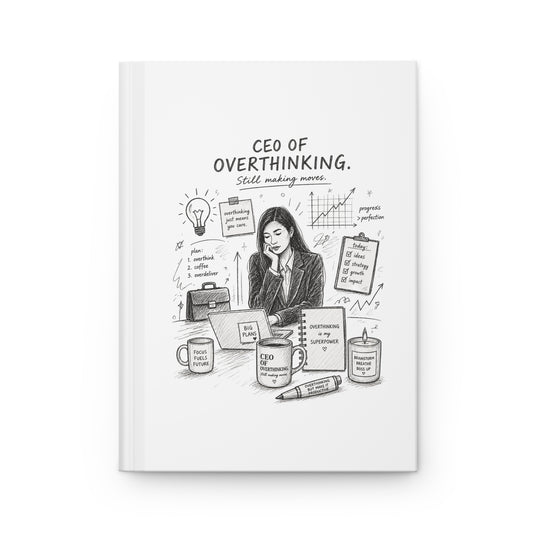
If you find yourself caught in thought loops—reconsidering the same decisions over and over—the CEO of Overthinking Journal was made for exactly that. It helps you work through the loop, make the call, and actually move forward.
What to Do With Decisions That Actually Matter
So far, we've removed or simplified smaller decisions.
Good.
Because that creates more room for the important ones.
When a decision genuinely deserves thought, don't just keep thinking harder.
Give the thinking structure.
Start with:
What am I actually deciding?
Write the decision in one sentence.
Not:
"What should I do with my career?"
Try:
"Do I want to accept this job offer?"
Much better.
What matters most in this decision?
Choose a few criteria.
Maybe:
- financial stability
- flexibility
- growth
- time
- relationships
- energy
- creativity
- location
- long-term direction
What are my real options?
Not every theoretical possibility.
The actual options currently available.
What does each option cost?
Money is one cost.
So are: time, attention, energy, opportunity, stress and commitments.
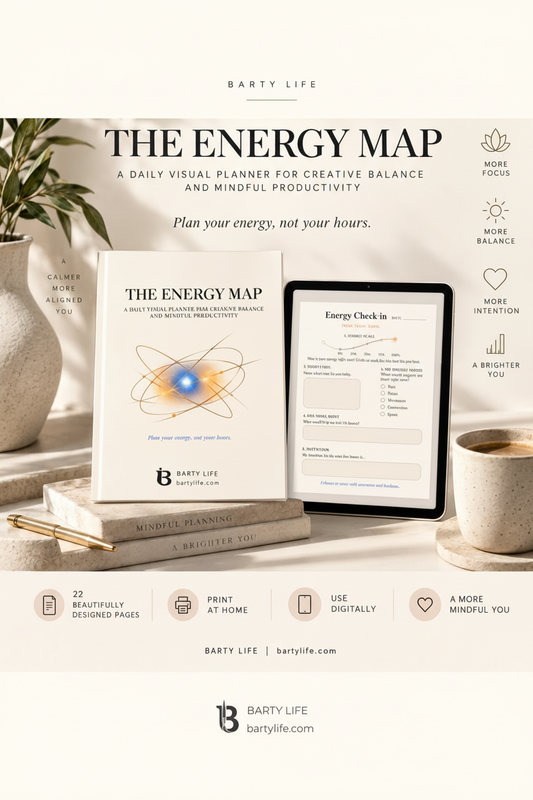
If you notice that your available energy is consistently shaping which decisions feel possible, The Energy Map can help you understand your capacity patterns and make decisions that work with your energy rather than against it.
Which option best supports the direction I want?
This is where decision-making moves beyond "Which option looks best?"
The better question may be:
Which option fits what I am trying to build?
A Simple Decision Reset
When you're stuck between options, take a blank page and write:
The decision: What exactly am I choosing?
What matters most: What are my top three criteria?
What I need: What do I genuinely need from this decision?
Option A: What does it give me? What does it cost?
Option B: What does it give me? What does it cost?
What am I afraid of: What outcome am I trying to avoid?
What is reversible: What could I change later?
My direction: Which option feels most aligned with what matters now?
Then stop.
Walk away for a little while if you can.
Come back and read what you wrote.
The goal isn't to extract a perfect answer from yourself.
It's to stop making the decision carry 47 unnamed questions at once.
Where The Clarity Compass Fits
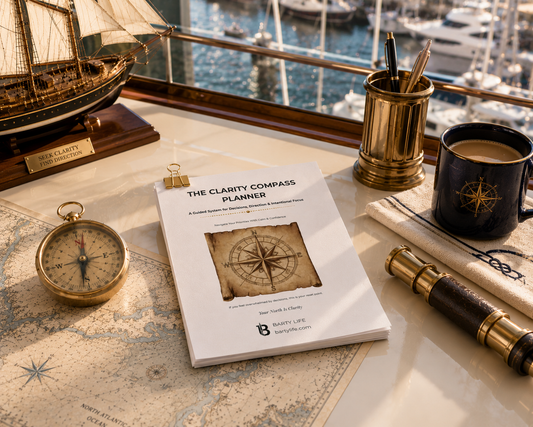
This is one reason The Clarity Compass isn't designed as another place to simply store tasks.
It includes a Decision Helper specifically for moments when you feel stuck or overwhelmed.
The process asks you to identify the decision, what you value most, what you need, your options, possible consequences, and how each choice aligns with your broader direction. It also includes space to notice what your energy may be communicating before identifying the choice that creates the most clarity.
That distinction matters.
You don't need a worksheet to decide which socks to wear.
Please just pick socks.
But when a decision keeps circling in your head, a structured page can move it from vague internal debate to something you can actually examine.
The Clarity Compass also uses daily direction, core priorities, distraction awareness, thought sorting and overwhelm-decluttering tools so that fewer decisions have to be improvised in the middle of an already busy day.
The goal isn't to turn life into a perfectly optimized system.
It's to create enough structure that your attention can go toward the decisions that deserve it.
Try a "Decision Diet" for One Week
Not fewer important decisions.
Fewer unnecessary ones.
For one week, choose three areas where you'll use defaults.
Maybe:
Breakfast: two options.
Work start: first priority chosen the night before.
Dinner: rough weekly theme.
Then choose one boundary:
I don't answer non-urgent messages while doing focused work.
And one stopping rule:
For purchases under $50, I compare no more than three suitable options.
Finally, choose one place for decisions that genuinely need thought.
A notebook.
A planner.
A notes document.
Somewhere you can write them down instead of repeatedly rehearsing them mentally.
At the end of the week, notice:
Which decisions disappeared?
Which still felt heavy?
Which deserved more attention?
Which never deserved as much attention as you were giving them?
That information is useful.
You Don't Need to Become Better at Deciding Everything
There will always be choices.
Some deserve careful thought.
Some deserve a quick answer.
Some can become routines.
Some can be delegated.
Some can use a default.
Some can wait until tomorrow.
And some decisions may not need to exist at all.
That's the larger lesson of decision fatigue.
The goal isn't to develop unlimited capacity for choosing.
It's to become more intentional about where you spend the capacity you already have.
So the next time choosing dinner feels like an unreasonable demand from the universe, maybe dinner isn't really the problem.
Ask how many decisions came before it.
Then see which ones you can stop making tomorrow.